

Choosing an Eco-Friendly Deicer
Dig Into... Snow & Ice



Do deicers have you feeling a little salty? From hardscape damage to risks to your pets and the environment, some deicers have an unsavory reputation. But the good news is, eco-friendly varieties are providing better ways to stay safe during the winter with less undesirable tradeoffs. Let’s dig into these smart and sustainable choices and why they should be part of your snow and ice removal plan.
Rock Salt and Runoff are Rough
While technically a natural product, rock salt has a long list of grievances, including those we mentioned above. But what many people don’t realize is that even if you don’t see immediate impact in the form of rusted metal or irritated paws, that doesn’t mean it’s not causing trouble downstream or below ground. Rock salt can infiltrate local waterways, raise salinity, and threaten aquatic life. And it can alter soil pH, causing damage to your landscape in the long-term.
Eco-Friendly Deicers are Just as Effective
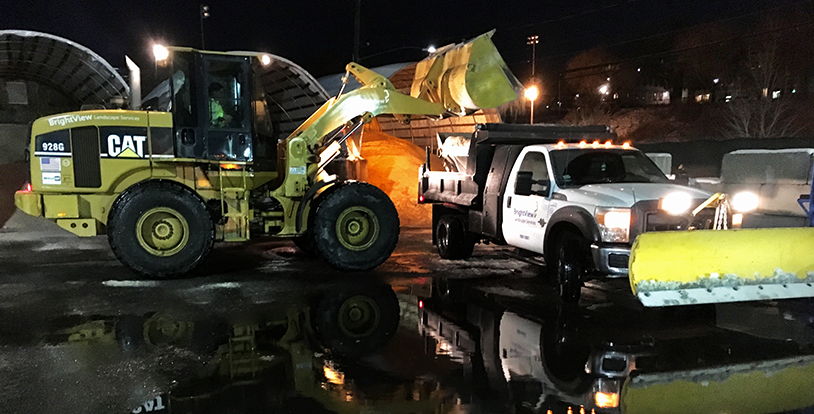
Thankfully, eco-friendly deicers are a gentler alternative. And better yet, they don’t sacrifice efficacy. In fact, eco-friendly deicers can melt ice just as well as traditional rock salt, but it’s important to choose the right formulation. Each has their own pros and cons, and some options work better than others at lower temperatures. In general, eco-friendly deicers fall into three categories:
Acetate-Based Deicers
Acetate-based deicers—including Calcium Magnesium Acetate (CMA) and Potassium Acetate)—are favored because they’re biodegradable and low-corrosive. CMA is much less expensive, making it the more economical choice for large-scale applications. However, its lowest effective temperature is 15-degrees Fahrenheit, compared to Potassium Acetate’s range of -20 to -75-degrees Fahrenheit, depending on the formulation. For this reason, Potassium Acetate is preferred for targeted deicing of high-priority areas, such as runways and bridges.
Formate-Based Deicers
On the other hand, if you’re near a stream or stormwater system, you may want to consider a formate-based deicer, such as Sodium Formate or Potassium Formate. Formates require less oxygen to biodegrade than acetates, which reduces the risk of suffocating local aquatic life. Plus, formates have angular granules (compared to acetate’s spherical pellets), which gives it better traction, enabling it to stay where applied, even under heavy crosswinds. Sodium formate is effective to 10-degrees Fahrenheit, while Potassium formate works down to -15 to -60-degrees Fahrenheit.
Advanced Eco-Blends
Finally, another option are blends that repurpose agricultural by-products (such as beet juice) to boost the performance of milder mineral salts (such as CMA). Why does this unlikely pairing work? As mentioned, one of the downsides of CMA is that it can easily be dispersed by wind or passing cars. Beet juice helps it stick to the surface where it’s applied. Further, it can also lower the effective working temperature of the solution.
That said, eco-blends also have some drawbacks. Unlike formates, they have a high biochemical oxygen demand, which can lead to oxygen depletion for aquatic life. And, as you can imagine with materials like beet juice, the resulting staining and odors can be problematic in certain environments.
Ultimately, selecting the right deicer is just one part of the equation; efficient manual removal of snow and ice remains the most environmentally friendly way to keep your walkways clear during inclement weather. That means enlisting a snow and ice removal partner you can count on to provide a swift response, appropriate staffing, and clear communication through every storm. From demystifying your deicer options to creating a thoughtful and through snow removal plan, our experienced local teams will make your winter truly worry-free. See for yourself by scheduling a free consultation.


